
Massachusetts Communities Confront Rising Property Taxes and Service Reductions Under Revenue Limits
Proposition 2½ leaves Massachusetts towns like Malden choosing between higher property taxes and service cuts.

In Massachusetts, a growing number of cities and towns are confronting the limits of their fiscal systems as expenses for essential public services continue to climb while the primary tool for raising local revenue remains tightly constrained. Right now, Malden is at a breaking point. City leaders are being forced to choose between cutting services or raising property taxes just to keep things running. And it’s not just happening there. Communities across the state are running into the same situation.
At a recent joint meeting between the School Committee and Select Board in my town, the reality was pretty clear. Schools need more funding, but the only real option being discussed is an override, which means higher taxes for residents. The same dynamic is playing out in places like Malden, where voters will decide on March 31, 2026, whether to approve one of two ballot questions allowing the city to collect an additional $5.4 million or $8.2 million in property taxes beyond the standard limits. City officials, including Mayor Gary Christenson, have described the situation as a structural deficit built up over years, driven largely by shortfalls in state education funding formulas, the exhaustion of temporary federal pandemic relief, and persistent inflation in areas like employee health insurance and special education services. Without the extra revenue, the city has warned of potential layoffs across departments, including public safety, libraries, public works, and schools—potentially affecting dozens of positions and reducing service levels that residents have come to expect.
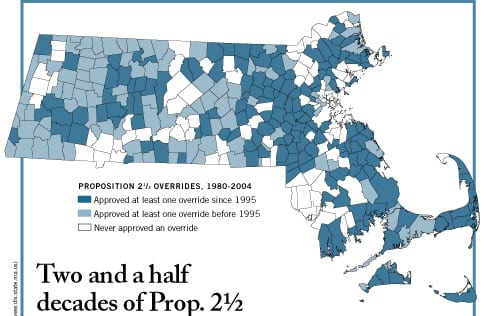
This pressure stems in large part from Proposition 2½, the 1980 voter-approved law that fundamentally reshaped how Massachusetts municipalities fund their operations. The measure caps the annual increase in a community’s total property tax levy at 2.5 percent of the previous year’s limit, plus any revenue from new growth such as newly constructed or improved properties. Communities can exceed that cap only if voters approve an override through a ballot question, which permanently raises the base levy limit for future years. The law was born out of a taxpayer revolt against rapidly escalating property taxes in the late 1970s, when rates in some areas reached $60 to $80 per $1,000 of assessed value. Supporters at the time viewed it as a necessary check on local government spending and a way to protect homeowners from unpredictable tax bills. Over the decades, it has provided a measure of predictability: nearly 200 of the state’s 351 cities and towns have not pursued any overrides in the last 15 years, according to data from the Department of Revenue. Yet in an environment of rising costs and uneven state support, the cap has left many local budgets with little room to maneuver.
Costs keep rising, local aid isn’t keeping up, and cities and towns are stuck trying to close the gap however they can. Across Massachusetts, municipal leaders point to a combination of factors squeezing their budgets. Inflation has hovered above 3 percent annually in recent years, outpacing the 2.5 percent levy growth allowance. Employee health insurance premiums have climbed by double digits in some years, while pension obligations and special education mandates—often driven by state and federal requirements—add fixed expenses that local officials have limited control over. Public safety departments face overtime spikes from staffing shortages and retirements, and infrastructure needs, from road repairs to school maintenance, continue to mount. Meanwhile, unrestricted general government aid from the state, which provides flexible funding for day-to-day operations, has declined in real, inflation-adjusted terms by about 25 percent since 2002, according to an analysis by the Massachusetts Municipal Association. Overall state aid makes up roughly 26 percent of local revenue in Massachusetts, compared to a national average of 31 percent for cities and towns. Chapter 70 school aid, the largest pot of targeted state support, has increased in recent years through reforms like the Student Opportunity Act, but gaps persist, particularly for certain districts where enrollment trends or cost formulas do not fully align with actual needs.
The result has been a surge in override proposals. In fiscal years 2025 and 2026, the total value of override questions on ballots across the state approached $240 million—more than the combined total from the previous seven years. Suburban communities have been the most active in pursuing them, often successfully, while gateway cities and rural towns face steeper political and economic hurdles. In Melrose, for instance, voters rejected an override in 2024, prompting cuts that included dozens of school and city jobs, reduced library hours, and scaled-back trash and road services. After extensive community outreach, residents approved a $13.5 million override in 2025, allowing some restorations but not a full return to prior levels. Arlington is considering a $14.8 million override this month to avert widespread school and town staffing reductions, including the potential closure of a library and cuts to elder services. Brookline may place an even larger question—potentially exceeding $18 million—on its May ballot to prevent teacher layoffs and maintain programming. In other areas, from Natick to Stoneham, similar debates have unfolded, with officials emphasizing that overrides are not about expansion but about preserving existing service levels.
The cycle keeps repeating itself, and it raises a bigger question about how our communities are being supported in the first place. For residents, the trade-offs are tangible. Property taxes already represent the largest single source of local revenue, and in many communities, residential properties shoulder a disproportionate share as commercial development lags. An average single-family home in Malden, valued around $666,000, could see an additional annual tax increase of roughly $353 to $533 depending on which override passes, though a residential exemption might soften the blow for some. Homeowners on fixed incomes, seniors, and middle-class families already navigating Massachusetts’ high cost of living—housing, utilities, and everyday expenses—often express concern that repeated overrides compound affordability pressures. Critics of frequent tax hikes argue that municipalities should first pursue efficiencies, such as shared services across towns, stricter controls on overtime, or prioritizing core functions over less essential programs. Some point to local development decisions or long-term budgeting practices as contributing factors, suggesting that overrides merely delay tougher conversations about spending priorities.
On the other side, municipal officials and service advocates contend that the constraints of Proposition 2½, combined with state mandates and inadequate aid growth, leave little choice but to seek voter approval or accept service reductions that erode quality of life. Schools, which consume a significant portion of most local budgets, face particular strain from rising special education costs and the need to attract and retain staff amid competitive labor markets. Public safety departments warn that staffing shortfalls could lead to slower response times or reduced community policing. Libraries and parks, often seen as community anchors, risk curtailed hours or closures, affecting everything from after-school programs to senior activities. Data from the Massachusetts Municipal Association’s “A Perfect Storm” report underscores the broader pattern: after adjusting for inflation, municipal operating spending grew at just 0.6 percent per year between 2010 and 2022, far below the state government’s 2.8 percent growth rate and even trailing the national average for local governments. Three out of four communities are operating at 95 to 99 percent of their allowable levy limit, meaning they have almost no buffer left under the current rules.
This situation highlights structural tensions in Massachusetts’ approach to local governance. Proposition 2½ was designed to empower voters and restrain tax growth, and in many respects it has succeeded in keeping property tax burdens more predictable than in states without similar caps. Yet its rigidity can amplify inequities across community types. Wealthier suburbs with strong property values and engaged electorates often secure overrides to maintain high service standards, while gateway cities like Malden—dealing with lower per-household assessed values and higher poverty rates—find overrides politically and economically challenging despite acute needs. Rural towns, meanwhile, may have levy capacity on paper but lack the income base or growth to generate meaningful new revenue. State aid formulas attempt to address disparities, but analyses show uneven distribution: some communities receive far more unrestricted aid per resident than others with comparable property wealth and income levels.
In response, the Massachusetts Municipal Association has called for reforms, including a $351 million increase in unrestricted local aid for fiscal year 2027, tying future aid growth to state tax collections, and modifications to Proposition 2½ such as allowing phased overrides over multiple years or indexing the cap to inflation. Proposals also include granting municipalities limited authority for other local revenue sources, like excise taxes on meals or hotels, to reduce overreliance on property taxes. State lawmakers face their own constraints, including pressures to control overall spending and address the high cost of living that affects residents statewide. Governor Maura Healey’s administration has not endorsed repealing Proposition 2½, focusing instead on targeted aid increases and economic development initiatives that could expand the property tax base through new growth.
Ultimately, the debate reflects competing priorities: protecting taxpayers from unchecked local spending while ensuring that communities can deliver the education, safety, and infrastructure services that underpin economic vitality and resident well-being. Massachusetts should be in a position where towns aren’t forced into override votes just to maintain basic services. Whether through enhanced state support, targeted adjustments to revenue rules, or greater local innovation in budgeting and growth strategies, finding a sustainable balance will require acknowledging that the current framework, while protective in many ways, increasingly tests the capacity of cities and towns to adapt to modern fiscal realities. As more communities head to the polls this year, voters across the state will weigh these trade-offs, deciding not only on immediate tax bills but on the kind of public services they expect—and are willing to fund—for the long term. The outcomes in places like Malden could signal whether this cycle of constrained budgets and last-minute appeals continues or whether broader policy changes emerge to ease the pressure on local governments and the residents they serve.

Support my run for State Representative - 9th Bristol District in Massachusetts